Resonator spectroscopy
Finding the readout resonator is the first measurement made on a new chip: sweep the frequency of the tone sent down the readout line and watch where the transmitted amplitude dips. Until that dip is located there is no readout, and without readout none of the other pages have a measurement to make. The program is the shortest one in this section, two operations inside two blocks.
What it is here to show is not its length. Every other example sweeps something the sequencer owns, a gain register or an NCO word or a waveform parameter, and the whole program runs in real time. A local oscillator is not that. It is a synthesizer reprogrammed over a control interface, so retuning it is platform configuration rather than an instruction in a pulse sequence, and a sweep that retunes one per iteration cannot run on the sequencer at all. That fact propagates outward through the program, and this page is about reading where it went and rewriting the program so it costs less.
The program
import qprogram as qp

schema = qp.BusSchema.transmon()
q = schema.q

program = qp.QProgram(
    label="resonator_spectroscopy",
    description="Sweep the readout LO across the resonator",
    schema=schema,
)
lo = program.variable("lo", label="Readout LO", units="Hz")

with program.average(shots=1000):
    with program.sweep(lo, qp.Linspace(7.0e9, 7.4e9, num=101)):
        program.set_parameter(q[0].readout, "lo_frequency", lo)
        m0 = program.measure(q[0].readout, "readout", "weights")
Why each piece is where it is
set_parameter(bus, parameter, value) writes a bus-scoped parameter. It is the operation for things a platform holds as configuration rather than as sequencer state, and platforms expose it host-side only for that reason. The parameter name is a free string that nothing validates at build time or at run time: "lo_frequency" means whatever the platform decides it means, and a typo becomes a parameter the platform has never heard of rather than an error.
There is no play in the loop. measure plays the readout waveform and acquires against the weights itself, so a resonator sweep needs nothing else, and no sync either since only one bus is involved. This is a one-tone measurement, which is what separates it from the two-tone qubit spectroscopy scan: there the drive tone interrogates the qubit and a separate readout reports on it, while here the readout tone is both the probe and the measurement.
The window covers 400 MHz because a resonator's position is known only to within the spread of the fabrication run, and 101 points put a sample every 4 MHz, comfortably finer than a linewidth of a few hundred kHz would need but coarse enough to find the dip in one pass. The fine scan comes after.
What the platform makes of it
#!QProgram 0.2

metadata:
  label: "resonator_spectroscopy"
  description: "Sweep the readout LO across the resonator"

schema:
  element q:
    drive info=IQ
    readout info=IQ+acquires

body:
  var lo label="Readout LO" units="Hz"

  average 1000:
    for lo in Linspace(start=7000000000.0, stop=7400000000.0, num=101):
      set_parameter q[0].readout "lo_frequency" lo
      measure q[0].readout "readout" "weights" name="q0/readout/m0"
Nothing in that file says anything about domains. Where each node can run is a question about a platform, so it is answered by qp.validate and rendered by qp.explain against a capability descriptor:
plan for 'resonator_spectroscopy' — errors: 0 · warnings: 1 · info: 1
body
└─ average 1000:                                                           [host]     ~ forced-host: contains host-side-only sub-block 'Sweep' (parameter 'lo_frequency' is swept via set_parameter (host-side dispatch per iteration))  i reorderable-averaging: Block 'Average' runs host-side only because it encloses a host-side sweep; its measurement sequence supports real-time hardware. Moving the sweep outside the average (hoisting the host-side-only setup with it) would let the averaging run in real-time hardware — see qprogram.optimize().
   └─ for lo in Linspace(start=7000000000.0, stop=7400000000.0, num=101):  [host]
      ├─ set_parameter q[0].readout "lo_frequency" lo                      [host]
      └─ measure q[0].readout "readout" "weights" name="q0/readout/m0"     [rt|host]
The measurement is [rt|host], so the sequencer could run it. Everything above it is [host], and the reason is a chain: the set_parameter is host-side only, which makes the sweep containing it host-side only, which makes the average containing that host-side only. The forced-host warning is emitted once, on the outermost block of that chain, because reporting it on all three would say the same thing three times.
The cost is in the innermost block that got dragged. An averaging block that runs host-side is a thousand separate acquisitions per sweep point, each with its own round trip between the host and the instrument, where a real-time average is one instruction the sequencer executes a thousand times. See Capabilities, diagnostics, and profiles for how the domain of a block is decided and what the other diagnostic codes mean.
Rewriting it with qp.optimize
The reorderable-averaging hint on the same row names the fix. The sweep has to stay host-side, since the LO is what it is, but it does not have to be inside the average. Turn the nesting inside out and the averaging is back on the sequencer:
body:
  var lo label="Readout LO" units="Hz"

  for lo in Linspace(start=7000000000.0, stop=7400000000.0, num=101):
    set_parameter q[0].readout "lo_frequency" lo
    average 1000:
      measure q[0].readout "readout" "weights" name="q0/readout/m0"
qp.optimize(program, caps) returns a new program and never touches the one it was given. The rewrite lifts the sweep to the outside, hoists the leading run of host-side-only operations along with it, and leaves the rest inside a fresh average. Re-explaining the result reports errors: 0 · warnings: 0 · info: 0, with the average now [rt|host] and only the sweep and the parameter write still [host].
It is opt-in rather than automatic because it is not unconditionally equivalent. It groups all thousand shots of one frequency together instead of interleaving passes over the whole window, which averages out drift differently and is identical only for a system that is not drifting. It also moves each hoisted operation from once per shot to once per sweep point, which is harmless for an idempotent parameter write and is not harmless in general. The rewrite protects itself by only ever hoisting a leading contiguous run, never an operation that sits after one it is keeping, since that would reorder the two.
The pattern it matches is narrow, and it is worth seeing it decline. Nest a second sweep inside the first and the average is still forced host-side, but the hint is gone and qp.optimize returns the program unchanged:
with program.average(shots=1000):
    with program.sweep(lo, qp.Linspace(7.0e9, 7.4e9, num=101)):
        program.set_parameter(q[0].readout, "lo_frequency", lo)
        with program.sweep(power, qp.Linspace(0.1, 1.0, num=10)):
            program.set_gain(q[0].readout, power)
            program.measure(q[0].readout, "readout", "weights")
# [warning] forced-host: ... and no reorderable-averaging hint
The average's sole child must be one flat sweep whose body holds no nested block. The hint and the rewrite share the same predicate, so the two can never disagree: an absent hint means an absent rewrite, and reading the diagnostics is how you find out that calling optimize did nothing.
Running it
The parameter store lives on the platform rather than in the program, so this is the one example that builds a qp.ReferencePlatform directly instead of going through qp.simulate. Keeping the platform is what lets the writes be read back afterwards:
import warnings

library = {
    "readout": qp.waveforms.IQPair(qp.waveforms.Square(1.0, 2000), qp.waveforms.Square(0.0, 2000)),
    "weights": qp.waveforms.IQPair(qp.waveforms.Square(1.0, 2000), qp.waveforms.Square(1.0, 2000)),
}


def notch(bus, env):
    """A resonator dip: unit transmission away from 7.2 GHz, zero at it."""
    f = env["q0/readout.lo_frequency"]
    return 1.0 - 1.0 / (1.0 + ((f - 7.2e9) / 4e6) ** 2) + 0j


platform = qp.ReferencePlatform(
    schema=schema,
    model=qp.MockMeasurementModel(response=notch, noise=0.005),
)

with warnings.catch_warnings():
    warnings.simplefilter("ignore", qp.ExecutionWarning)
    result = platform.execute(program.with_waveforms(library))

result.get(m0).dims  # ("lo", "IQ")
result.get(m0).shape  # (101, 2)
platform.parameters  # {"q0/readout.lo_frequency": 7400000000.0}
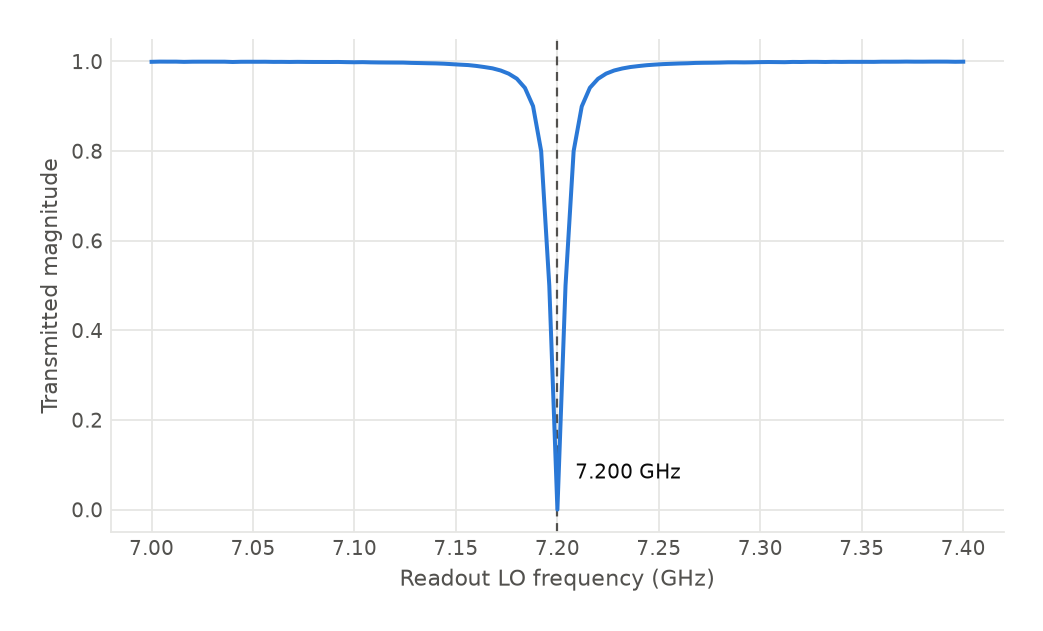
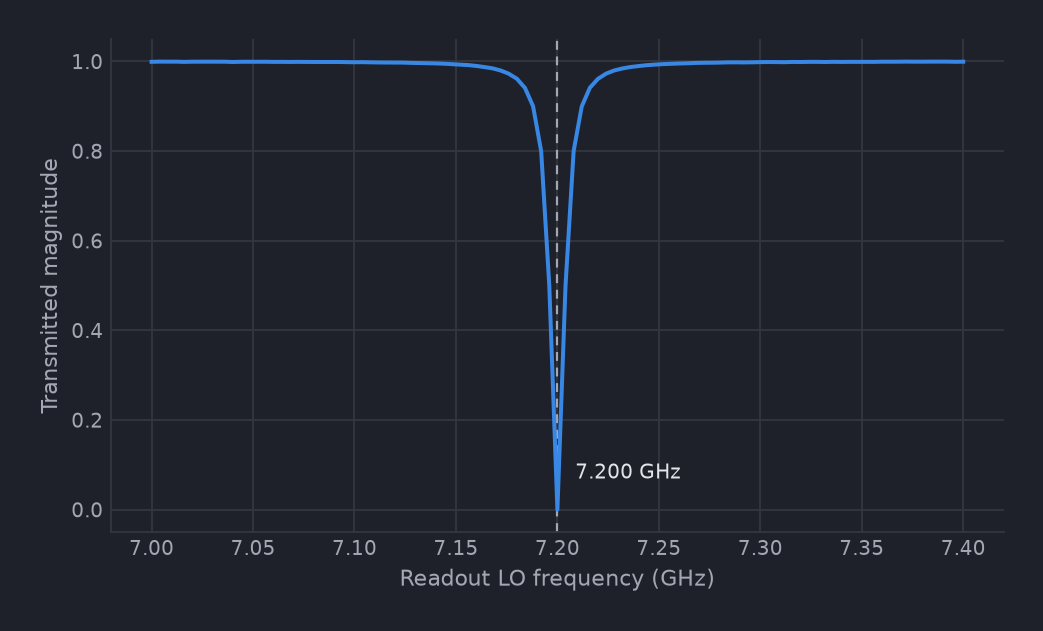
The dip is the resonator, and its centre is the frequency the readout pulse wants to be at.
A swept parameter reaches the model differently from a swept variable. The earlier pages read env["freq"] or env["delay"], the id of the loop variable; a parameter write puts its value in the same env under "bus.parameter", so the model reads env["q0/readout.lo_frequency"]. Both are available at once, and here the loop variable env["lo"] holds the same number, but the parameter key is what a model should use, because it reports what the instrument was actually configured to rather than what a loop happened to be carrying.
platform.parameters survives the run and holds the last value written, which is 7.4e9, the end of the sweep. The store is copied at construction and then read by get_parameter, written by set_parameter, and passed to the model, so writes accumulate across successive execute calls on the same platform. qp.simulate builds a throwaway platform and discards it, which is why it is the wrong entry point when the parameter store is part of what you are looking at.
The forced-host warning is re-emitted at execution as a qp.ExecutionWarning rather than being raised, since the program does run, just not the way it was written. Filtering it, as above, is reasonable once you have read it; leaving it unfiltered is better while the program is still changing. Errors are not handled this way: an error diagnostic raises UnsupportedOperationError and nothing executes.
Adapting it
To read a parameter rather than write one, get_parameter returns a freshly declared variable the runtime fills in:
current = program.get_parameter(q[0].readout, "lo_frequency")
# var q0_readout_lo_frequency label="q0/readout.lo_frequency"
# get_parameter q[0].readout "lo_frequency" -> q0_readout_lo_frequency
The variable id is derived from the bus and parameter with the non-word characters replaced, and the original dotted form is kept as the label. From there it is an ordinary variable and can be used in any expression.
A punchout measurement adds a power axis outside the frequency one and watches the dip move as the resonator is driven past its critical photon number. That is the nested shape qp.optimize declines, which is the honest trade: the second axis costs the real-time averaging back.
The same experiment is not host-side on every instrument. A platform whose readout chain has its own NCO can sweep the tone with set_frequency instead of retuning an LO, and then nothing here happens at all: the sweep is [rt|host], the average never falls back, and there is no rewrite to apply. Which of the two a program should be written against is a capability question you can ask before running anything, with qp.explain against that platform's descriptor.