Active reset
A shot cannot start until the qubit is back in its ground state, and waiting for it to get there on its own costs several relaxation times per shot. Active reset measures the qubit instead and plays a pi pulse only if the measurement says it is excited, which puts the repetition rate under the readout time rather than under T1. The decision is made inside the shot, between two operations, from a value that does not exist until the program is running.
That is the feature this page is about. Every program on the earlier pages is a fixed sequence whose shape is known when the file is written; this one branches on a measurement, so the .qp text describes two possible sequences and the instrument picks one per shot. The reset is put in front of a small Rabi sweep rather than left on its own, because a conditional is something you add to an experiment rather than something you run.
The program
import numpy as np
import qprogram as qp

schema = qp.BusSchema.transmon()
q = schema.q

program = qp.QProgram(
    label="active_reset",
    description="Conditional reset before a Rabi sweep on q0",
    schema=schema,
)
amp = program.variable("amp", label="Drive amplitude", units="V")

with program.average(shots=1000):
    with program.sweep(amp, qp.Linspace(0.0, 1.0, num=21)):
        check = program.measure(
            q[0].readout,
            "readout",
            "weights",
            fields=(qp.MeasurementField.STATE,),
        )
        with program.if_(check.state == 1):
            program.play(q[0].drive, "pi")
        with program.else_():
            program.wait(q[0].drive, 40)

        program.sync()
        program.set_gain(q[0].drive, amp)
        program.play(q[0].drive, "pi")
        program.sync()
        m0 = program.measure(
            q[0].readout,
            "readout",
            "weights",
            fields=(qp.MeasurementField.IQ, qp.MeasurementField.STATE),
        )
Why each piece is where it is
check is the herald. It asks only for MeasurementField.STATE, because the program needs the classified outcome and nothing else from it, and requesting IQ as well would record an array per sweep point that no one reads. The handle it returns is what the conditional refers to.
check.state is a proxy whose == and != operators build the comparison the conditional needs. It is not a variable and it holds no value at build time; it names a measurement and a field, and the instrument resolves it when the shot reaches the branch. The comparison is against 1 because the classifier reports an integer state, so the arm runs on the shots that came back excited.
Each arm is a separate with statement, and the chain is held open by adjacency: elif_() and else_() must follow the arm they extend with nothing appended in between. Appending any other operation between two arms closes the chain, and the elif_() that follows then raises rather than silently starting a new one.
The else_ arm waits 40 ns, the length of the pi pulse, so both paths through the branch take the same time. Nothing in the language requires that and the reference executor does not measure it, but a branch whose arms have different durations leaves the buses at different times on hardware, which the sync() after the chain is what resolves.
The rest is the Rabi program: set the gain from the swept variable, play the pulse, sync, and measure. That second measurement asks for both fields, since the IQ point is the Rabi curve and the state is what a fidelity is computed from.
What it produces
#!QProgram 0.2

metadata:
  label: "active_reset"
  description: "Conditional reset before a Rabi sweep on q0"

schema:
  element q:
    drive info=IQ
    readout info=IQ+acquires

body:
  var amp label="Drive amplitude" units="V"

  average 1000:
    for amp in Linspace(start=0.0, stop=1.0, num=21):
      measure q[0].readout "readout" "weights" name="q0/readout/m0" fields=["state"]
      if q0/readout/m0.state == 1:
        play q[0].drive "pi"
      else:
        wait q[0].drive 40
      sync
      set_gain q[0].drive amp
      play q[0].drive "pi"
      sync
      measure q[0].readout "readout" "weights" name="q0/readout/m1" fields=["state", "iq"]
The condition is written as the measurement's name followed by the field, which is why every measurement carries name= in the file even when the name was allocated for it: the conditional is a reference by name, and a reload that reallocated names would point the branch somewhere else. Both measurements are on q0/readout and the per-bus counter distinguishes them, giving m0 and m1. A name you supply yourself does not consume a counter slot, so passing name="herald" to the first one leaves the other two as m0 and m1.
What the condition can be
The accepted shape is one comparison between a measurement state and an integer literal. That is narrower than the expression language everywhere else in a program, and deliberately so: this is the one condition a sequencer has to evaluate in real time, between two pulses, without a host round trip.
Everything else is rejected where it is written. Comparing against a non-integer raises at the operator, before if_ is reached:
check.state == 1.0  # TypeError: handle.state can only be compared to int, ...
check.state == True  # TypeError: handle.state cannot be compared to a bool; use 0 or 1 ...
check.state > 0  # TypeError: '>' not supported between instances of ...
A condition of the wrong shape gets past the operator and is caught by if_ itself, as a ValidationError:
program.if_(qp.and_(check.state == 1, other.state == 0))
# ValidationError: if_() expects a Comparison condition such as `handle.state == 0`
# or `handle.state != 1`; got LogicalBinaryOp

program.if_(qp.eq(amp, 1))
# ValidationError: if_() condition must reference at least one measurement-state ref
# (e.g. `handle.state`); got a comparison of Variable and Constant
The one failure that survives to validation is a herald that never asked to be classified. Drop fields= from the first measurement and the program still builds, because measure does not know a later conditional will refer to it:
diagnostics, plan = qp.validate(program, qp.reference_capabilities())
# [error] missing-classification: Conditional references q0/readout/m0.state, but the
# measurement does not request state classification (add MeasurementField.STATE to
# fields=) (at body[0][0][1])
This is enforced rather than advisory. qp.simulate validates before it executes, so the same program raises UnsupportedOperationError: program is not executable on the reference platform with that diagnostic attached, which is what a hardware platform does with it too. The path body[0][0][1] locates the conditional as the second child of the sweep, itself the first child of the average block; see Capabilities, diagnostics, and profiles for resolving a path back to a line of the file.
qp.explain renders the chain as a node of its own with the arms beneath it:
plan for 'active_reset' — errors: 0 · warnings: 0 · info: 0
body
└─ average 1000:                                                                               [rt|host]
   └─ for amp in Linspace(start=0.0, stop=1.0, num=21):                                        [rt|host]
      ├─ measure q[0].readout "readout" "weights" name="q0/readout/m0" fields=["state"]        [rt|host]
      ├─ if/elif/else chain                                                                    [rt|host]
      │  ├─ if q0/readout/m0.state == 1:                                                       [rt|host]
      │  │  └─ play q[0].drive "pi"                                                            [rt|host]
      │  └─ else:                                                                              [rt|host]
      │     └─ wait q[0].drive 40                                                              [rt|host]
      ├─ sync                                                                                  [rt|host]
      ├─ set_gain q[0].drive amp                                                               [rt|host]
      ├─ play q[0].drive "pi"                                                                  [rt|host]
      ├─ sync                                                                                  [rt|host]
      └─ measure q[0].readout "readout" "weights" name="q0/readout/m1" fields=["state", "iq"]  [rt|host]
Every row here is [rt|host], meaning the reference platform can run it in either domain. A platform whose readout chain cannot classify a state inside a sequence is the one that reports otherwise, and the chain is where it says so.
Running it
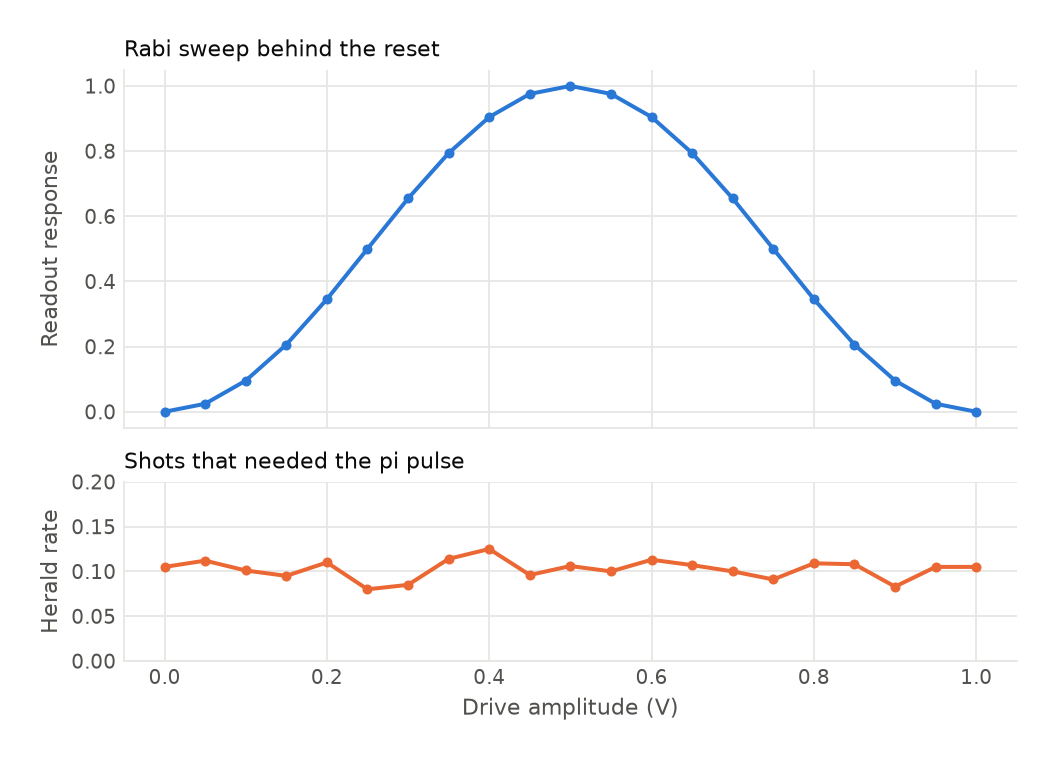
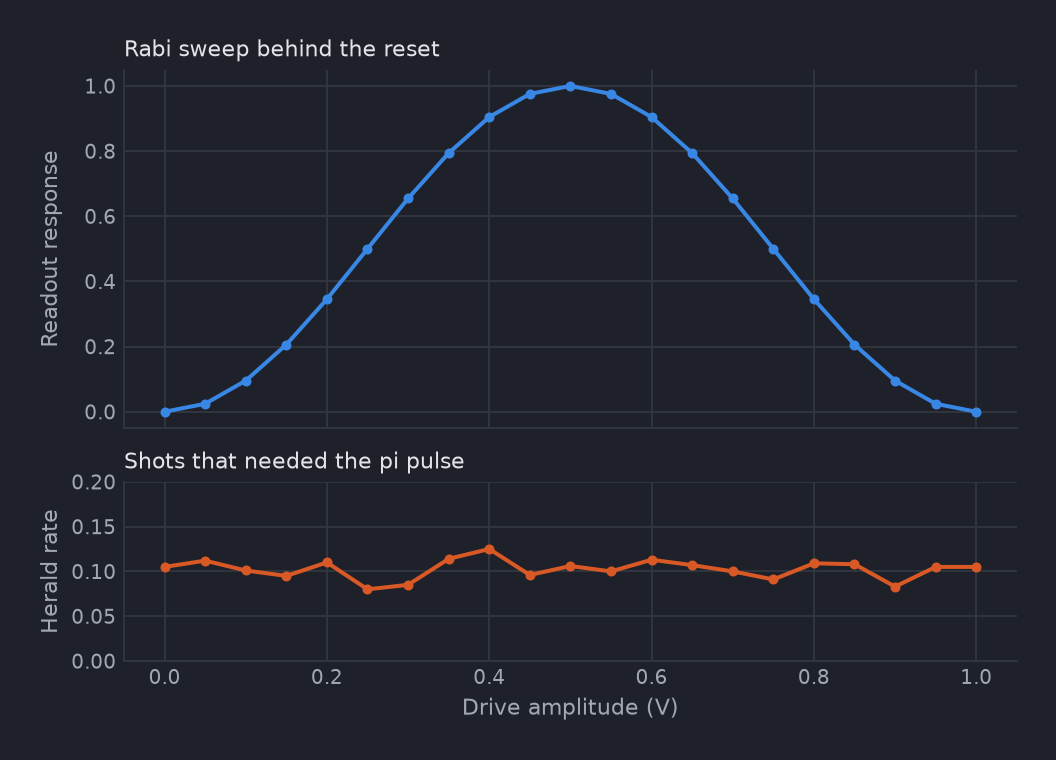
The herald needs a population to classify, which is what p_excited supplies. A tenth of the shots arriving excited is a reasonable stand-in for a qubit that has not fully relaxed since the previous shot:
library = {
    "pi": qp.waveforms.IQDrag(amplitude=0.5, duration=40, sigma=8, beta=0.1),
    "readout": qp.waveforms.IQPair(qp.waveforms.Square(1.0, 2000), qp.waveforms.Square(0.0, 2000)),
    "weights": qp.waveforms.IQPair(qp.waveforms.Square(1.0, 2000), qp.waveforms.Square(1.0, 2000)),
}

result = qp.simulate(
    program.with_waveforms(library),
    model=qp.MockMeasurementModel(
        response=lambda bus, env: np.sin(np.pi * env["amp"]) ** 2 + 0j,
        p_excited=lambda bus, env: 0.1,
    ),
)

result.get(m0).dims  # ("amp", "IQ")
result.get(m0).shape  # (21, 2)

heralds = result.get(check, field=qp.MeasurementField.STATE)
heralds.dims  # ("amp",)
heralds.mean()  # about 0.1, the fraction of shots that needed the reset pulse
The herald is a result record like any other, so how often the reset fired is data you already have rather than something to instrument for. Reading it is worth doing: a herald rate that climbs over a run is the readout heating the qubit or the previous shot's pulse leaking, and neither shows up in the Rabi curve until it has already distorted it.
Both records plotted against the same sweep, the Rabi curve above and the herald rate below, is the shape worth watching: the reset should hold flat while the experiment underneath it moves.
Asking check for a field it never requested raises rather than substituting one:
The branch is real in the reference executor even though the pulses are not. The interpreter classifies each herald shot from p_excited, evaluates the comparison, and walks one arm, so a measurement placed inside an arm is recorded only on the shots that took it. A grid point where an arm was never selected holds NaN, since the executor divides by a shot count of zero there:
with program.if_(check.state == 1):
    program.play(q[0].drive, "pi")
    reset_check = program.measure(q[0].readout, "readout", "weights")
# result.get(reset_check) is all NaN when p_excited is 0.0 everywhere
What the executor does not do is time anything. The pi pulse in the taken arm and the wait in the other are both no-ops, so the run says nothing about whether the reset would fit inside a real repetition period. See Running programs.
Adapting it
To verify the reset rather than assume it, measure again inside the arm that fired and read that handle back. The fraction of second heralds still reporting 1 is the reset infidelity, and it is the number that decides how many rounds are needed.
To make it more than one round, repeat the measure-and-branch pair. A Python for loop around it writes the rounds into the program at build time, each with its own handle, and the counter names them m0 through m3:
for _ in range(4):
    round_check = program.measure(q[0].readout, "readout", "weights", fields=(qp.MeasurementField.STATE,))
    with program.if_(round_check.state == 1):
        program.play(q[0].drive, "pi")
    with program.else_():
        program.wait(q[0].drive, 40)
Naming the repeated pair once with a fragment is the alternative, and it keeps the four rounds from being four copies in the file.
To branch on a three-level classifier, extend the chain with elif_:
with program.if_(check.state == 1):
    program.play(q[0].drive, "pi")
with program.elif_(check.state == 2):
    program.play(q[0].drive, "pi_ef")
    program.play(q[0].drive, "pi")
with program.else_():
    program.wait(q[0].drive, 40)
Only the first matching arm runs, and an else_ is optional; without one, a shot matching no arm does nothing. At most one else_ per chain, and it has to be last.
To condition on a measurement of a different qubit, pass that qubit's handle. The comparison names a measurement, not a bus, so nothing requires the branch to act on the qubit that was measured, which is what a parity check or a teleported correction needs. Whether a platform can route a classification from one readout chain to another sequencer in time is a capability question, and Capabilities, diagnostics, and profiles covers how it is declared.