Multiplexed readout
Readout resonators on a chip are spaced across one feedline so that a single line can interrogate all of them at once. A program that reads four qubits per shot is therefore not four experiments interleaved; it is one experiment with four records, and the drive sweep in front of it calibrates four pi pulses in the time one would take.
Two things follow from that, and they are what this page is about. Four measurements need four handles, which a Python loop produces along with the program itself. And four resonators are four different pulses under one alias, which is what qp.WaveformLibrary exists for: a plain dict maps a name to one waveform, while a library maps a name to a waveform per bus. Saving and loading documents the library and its .wfl format; here it decides what each qubit is actually sent.
The program
import numpy as np
import qprogram as qp

schema = qp.BusSchema.transmon()
q = schema.q
QUBITS = (0, 1, 2, 3)

program = qp.QProgram(
    label="multiplexed_rabi",
    description="One drive sweep, four qubits read out per shot",
    schema=schema,
)
amp = program.variable("amp", label="Drive amplitude", units="V")

handles = {}
with program.average(shots=1000):
    with program.sweep(amp, qp.Linspace(0.0, 1.0, num=21)):
        for i in QUBITS:
            program.set_gain(q[i].drive, amp)
            program.play(q[i].drive, "pi_pulse")
        program.sync()
        for i in QUBITS:
            handles[i] = program.measure(
                q[i].readout,
                "readout",
                "weights",
                fields=(qp.MeasurementField.IQ, qp.MeasurementField.STATE),
            )
Why each piece is where it is
The Python loop runs while the program is built, so it writes four set_gain and four play statements into the AST rather than a loop into the file. The index is a Python value, and q[i].drive resolves it to a bus at that moment.
The drives all come before the single sync, which is what makes this one shot rather than four. Each bus has its own timeline, so four pulses on four drive buses are concurrent until something aligns them; the sync then holds every readout until the last drive has finished.
handles is a dict rather than four names because the loop that builds it is the loop that decides how many there are. Every one of the four is named m0:
{i: h.name for i, h in handles.items()}
# {0: "q0/readout/m0", 1: "q1/readout/m0", 2: "q2/readout/m0", 3: "q3/readout/m0"}
The counter is per bus, so the bus prefix is what distinguishes these, not the number. Four measurements on four buses are all m0; three on one bus would be m0, m1, m2.
What it produces
#!QProgram 0.2

metadata:
  label: "multiplexed_rabi"
  description: "One drive sweep, four qubits read out per shot"

schema:
  element q:
    drive info=IQ
    readout info=IQ+acquires

body:
  var amp label="Drive amplitude" units="V"

  average 1000:
    for amp in Linspace(start=0.0, stop=1.0, num=21):
      set_gain q[0].drive amp
      play q[0].drive "pi_pulse"
      set_gain q[1].drive amp
      play q[1].drive "pi_pulse"
      set_gain q[2].drive amp
      play q[2].drive "pi_pulse"
      set_gain q[3].drive amp
      play q[3].drive "pi_pulse"
      sync
      measure q[0].readout "readout" "weights" name="q0/readout/m0" fields=["state", "iq"]
      measure q[1].readout "readout" "weights" name="q1/readout/m0" fields=["state", "iq"]
      measure q[2].readout "readout" "weights" name="q2/readout/m0" fields=["state", "iq"]
      measure q[3].readout "readout" "weights" name="q3/readout/m0" fields=["state", "iq"]
The schema block still declares one element with two bus kinds. It records what kinds exist, not which qubits a program touched, so four qubits in the body add nothing to it.
One alias, four pulses
Every example before this one resolved its aliases with a plain dict, which is one global tier: "readout" means the same waveform everywhere. Four resonators at four frequencies need four readout pulses, and a qp.WaveformLibrary keys an entry by a bus coordinate as well as a name:
library = qp.WaveformLibrary()
library.set(
    "readout",
    qp.waveforms.IQPair(qp.waveforms.Square(0.9, 1000), qp.waveforms.Square(0.0, 1000)),
    element="q",
    idx=0,
    kind="readout",
)
library.set(
    "readout",
    qp.waveforms.IQPair(qp.waveforms.Square(0.7, 3000), qp.waveforms.Square(0.0, 3000)),
    element="q",
    idx=2,
    kind="readout",
)
library.set(
    "readout",
    qp.waveforms.IQPair(qp.waveforms.Square(0.5, 2000), qp.waveforms.Square(0.0, 2000)),
    element="q",
    kind="readout",
)
library.set(
    "weights",
    qp.waveforms.IQPair(qp.waveforms.Square(1.0, 2000), qp.waveforms.Square(1.0, 2000)),
)
library.set("pi_pulse", qp.waveforms.IQDrag(0.5, 40, 8, 0.1))
element, idx, and kind are keyword-only and only three combinations are legal, one per tier: all three is an exact entry for one bus, element and kind is a family entry for every index of that kind, and none of them is a global entry. Any other combination raises ValidationError.
Lookup walks the three in order and takes the first hit, so the two qubits with their own entry get it and the rest fall through to the family:
for i in QUBITS:
    wf = library.get(q[i].readout, "readout")
    print(i, wf.I.amplitude, wf.get_duration())
# 0 0.9 1000     exact
# 1 0.5 2000     family
# 2 0.7 3000     exact
# 3 0.5 2000     family
The family tier is scoped by kind as well as element, so it covers q[*].readout and not q[*].drive. A bus with no entry at any tier resolves to None and the alias passes through the program as the string it was, which is why a partial library is not an error:
A raw-string bus reaches the global tier only, since a plain string carries no element or kind to match on. That is the trap in mixing raw-string buses with a tiered library: they silently get the global entry, or nothing.
What the library looks like on disk
A library is its own file with its own format and version, separate from the program:
#!WaveformLibrary 0.2
"readout" q[0].readout = IQPair(I=Square(amplitude=0.9, duration=1000), Q=Square(amplitude=0.0, duration=1000))
"readout" q[2].readout = IQPair(I=Square(amplitude=0.7, duration=3000), Q=Square(amplitude=0.0, duration=3000))
"readout" q[*].readout = IQPair(I=Square(amplitude=0.5, duration=2000), Q=Square(amplitude=0.0, duration=2000))
"weights" = IQPair(I=Square(amplitude=1.0, duration=2000), Q=Square(amplitude=1.0, duration=2000))
"pi_pulse" = IQDrag(amplitude=0.5, duration=40, sigma=8, beta=0.1)
The coordinate before the = is the tier: a concrete index is an exact entry, [*] is a family entry, and no coordinate at all is a global one. Entries are written in insertion order, and qp.WaveformLibrary.load("chip.wfl") returns a library that dumps byte-identically.
Two files rather than one is the point of the split. chip.qp says what the experiment is and changes when the experiment changes; chip.wfl says what this chip's pulses are today and changes after every calibration run.
Reading four records
resolved = program.with_waveforms(library)
result = qp.simulate(resolved, model=model)

result.get(handles[2], field=qp.MeasurementField.STATE).dims  # ("amp",)
result.get takes a handle, a name, or a position, and bus= narrows the search before any of them. All of these select the same record:
result.get(handles[2])  # the handle the builder returned
result.get("q2/readout/m0")  # its name
result.get(qp.MeasurementHandle("q2/readout/m0"))  # a handle rebuilt from the name
result.get(2)  # third measurement in the program
result.get(0, bus="q2/readout")  # first measurement on that bus
The position form is the one a loop wants, since result.get(i, ...) walks the records in the order the program declared them. Note that bus= filters first, so get(0, bus="q2/readout") is the first measurement on that bus rather than the first overall. Asking for a record that is not there raises rather than returning an empty array: KeyError: "No measurement named 'q0/readout/m0' on bus 'q1/readout'".
The four qubits only differ if the model makes them differ. sample receives the bus string, so one model describes the whole chip:
PERIOD = {"q0/readout": 1.0, "q1/readout": 2.0, "q2/readout": 3.0, "q3/readout": 4.0}


def rabi(bus, env):
    """Four qubits whose pi amplitudes differ by a factor of four across the chip."""
    return float(np.sin(np.pi * env["amp"] / PERIOD[bus]) ** 2)


model = qp.MockMeasurementModel(
    response=lambda bus, env: rabi(bus, env) + 0j,
    p_excited=rabi,
    noise=0.02,
    seed=0,
)

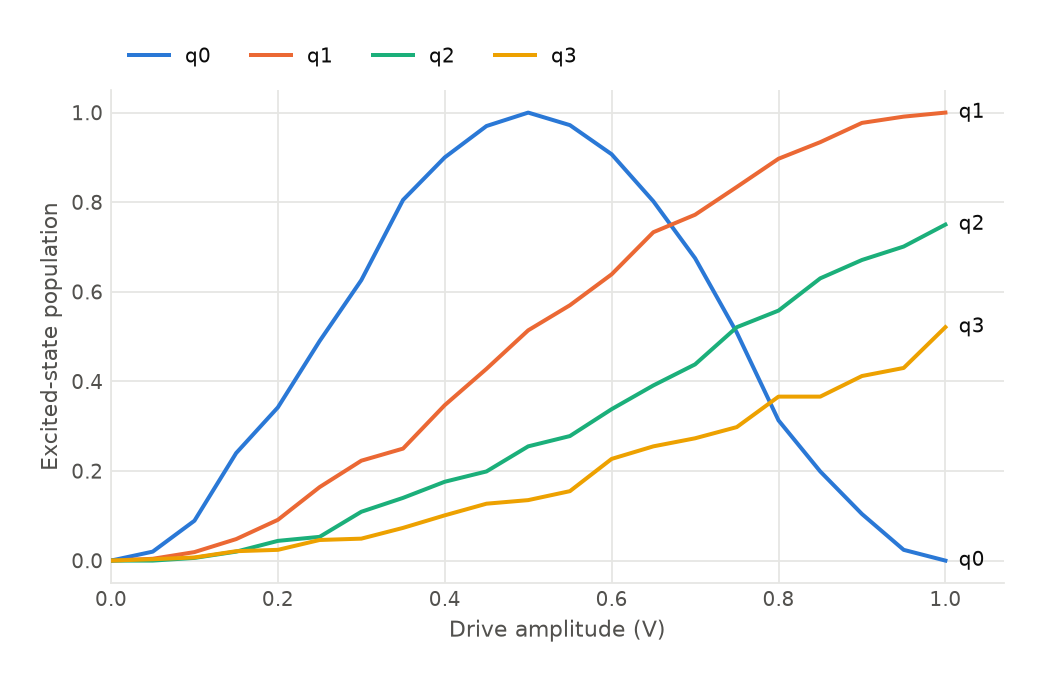
[float(result.get(i, field=qp.MeasurementField.STATE)[10]) for i in QUBITS]
# [1.0, 0.514, 0.255, 0.135]
Without the branch on bus all four records come back identical, which looks like a working multiplexed readout and is not one.
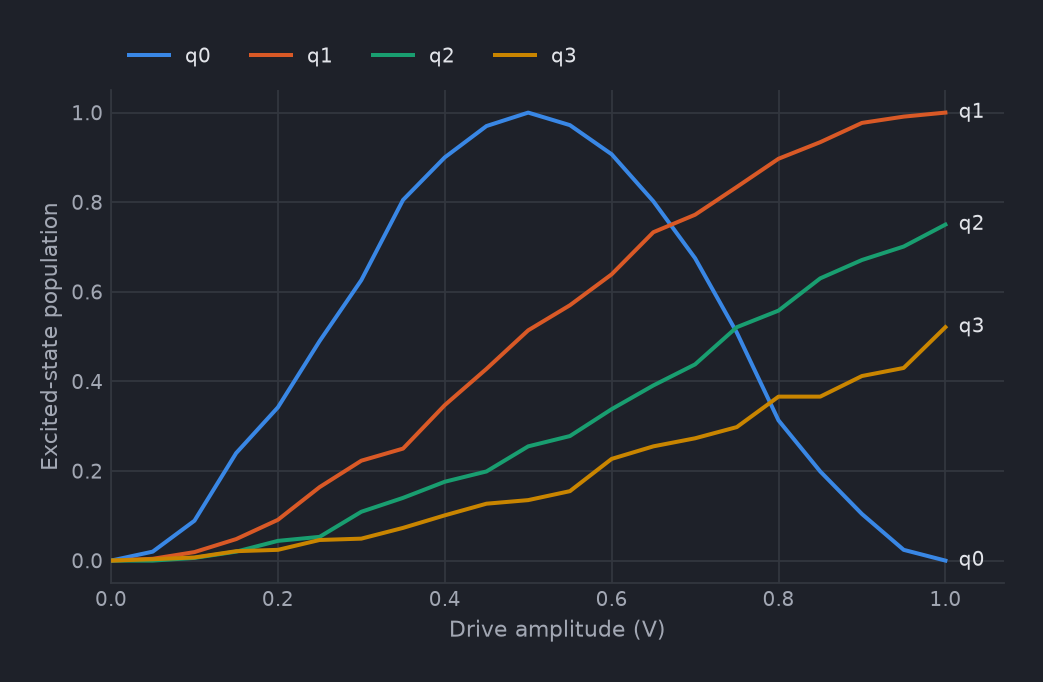
Four records off one shot, each qubit reaching its pi amplitude somewhere different, which is the calibration this measurement exists to produce:
Adapting it
To move a program to different qubits, rebind maps element indices and returns a copy:
Auto-allocated measurement names are re-derived from the new bus, so q0/readout/m0 becomes q5/readout/m0 and the .qp line becomes measure q[5].readout ... name="q5/readout/m0". A name you supplied yourself is left alone, since rebind can tell the two apart. Qubits not in the mapping pass through untouched and the original program is unchanged.
Porting also moves a bus out from under its library entry, which is the thing to watch:
program.with_waveforms(library)  # q[0].readout gets the exact entry, amplitude 0.9
ported.with_waveforms(library)  # q[5].readout gets the family entry, amplitude 0.5
The library is keyed on the coordinate, not on the program, so a program that was calibrated on q0 quietly plays the family pulse on q5. That is the right behavior, since the whole point of the coordinate is that q5 is a different resonator, but it does mean porting and calibrating are one step rather than two.
Rebind before serializing, not after loading. Whether a name was auto-allocated is in-memory state that .qp does not carry, so on a reloaded program rebind treats every name as user-supplied and leaves it stale: the bus becomes q[5].readout while the name stays q0/readout/m0.
A raw-string bus cannot be rebound at all, and rebind says so rather than leaving it behind:
ValidationError: rebind left raw-string bus(es) unported: 'legacy_readout'.
Raw strings carry no schema metadata to re-resolve — map them via strings={...}
(map a name to itself to keep it), or pass allow_unported_strings=True to leave
them in place.
Mapping one with strings={"legacy_readout": "new_readout"} moves the bus, but the value stays a plain string, so its measurement keeps the global m0 prefix and the name will not track the bus. A schema is what makes porting work.
To scale past four, QUBITS is the only line that changes. Eight qubits give eight records read the same way, and the cost of the run is linear in the number of buses.